
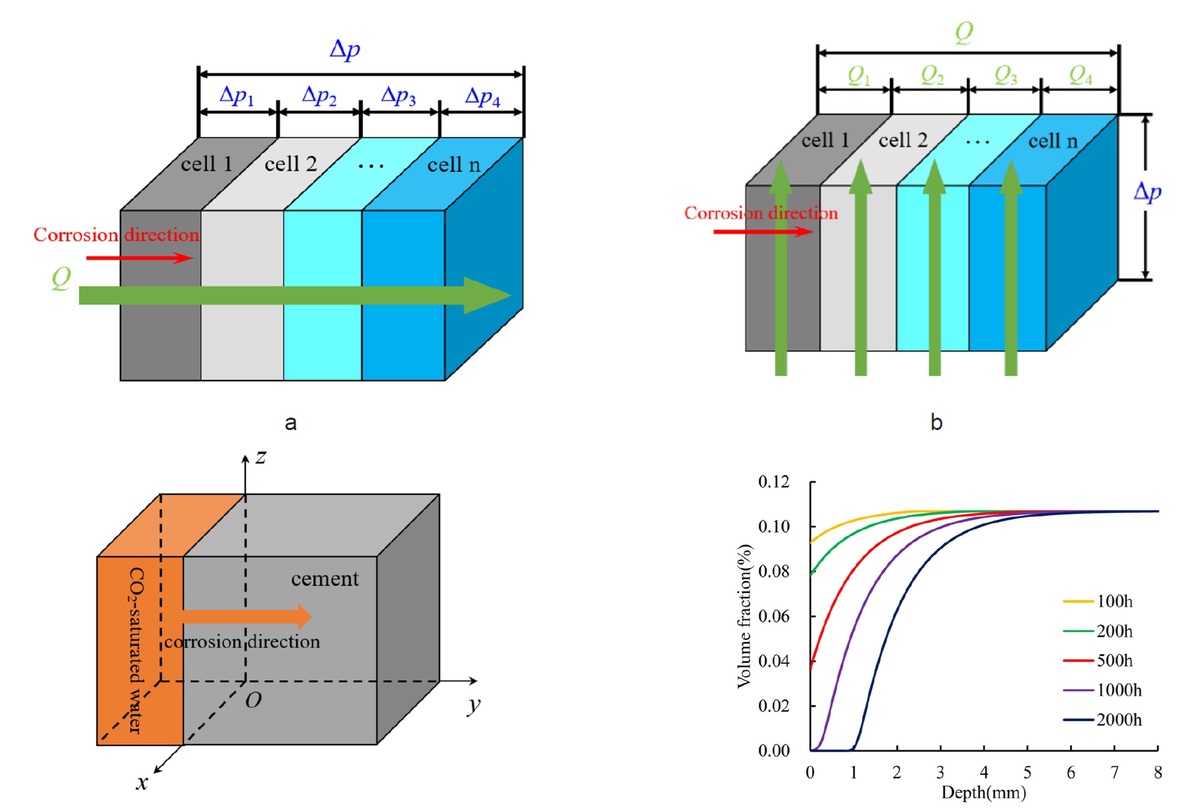
Simulation of the two-direction permeability of oilwell cement in CO2-saturated water
1
Department of Petroleum Engineering, Northeast Petroleum University, Daqing 163318, China
2
Petrochina Daqing Oilfield, Daqing, Heilongjiang, 163453, P.R. China
3
CNPC Tubular Goods Research Institute, Xi’an, Shaanxi, 710077, P. R. China
These authors had equal contribution to this work
Submission date: 2024-05-14
Final revision date: 2024-11-04
Acceptance date: 2026-01-26
Publication date: 2026-02-09
Corresponding author
Cement Wapno Beton 30(3) 244-262 (2025)

KEYWORDS
TOPICS
ABSTRACT
In the process of geological carbon sequestration, the CO2 injected into the formation will react with the hollow cement ring or wellbore cement plug, and reduce the sealing performance of the cement body to further destroy the integrity of the wellbore, causing CO2 leakage and seriously affecting the efficiency of CO2 storage. This study aimed to investigate the effect of CO2 on the sealing performance of cement stone in the wellbore under the condition of CO2 geological storage. For this purpose, a reaction transport model of CO2-corroded cement stone was created and calibrated based on laboratory tests. The results show that the corrosion area of cement stone is a layered structure, resulting in anisotropy of sealing performance of cement stone. The permeability of cement stone perpendicular to the corrosion direction increases with the increase of corrosion depth, while the permeability along the parallel corrosion direction first decreases and then increases. After 2000 hours of corrosion, the permeability increase of cement stone perpendicular to the corrosion direction is greater than that parallel to the corrosion direction by 12 %.
REFERENCES (40)
1.
B. Stefan, J.J. Adams, Sequestration of CO₂ in geological media in response to climate change: Capacity of deep saline aquifers to sequester CO₂ in solution. Energy Convers. Manag., 44, 3151–3175 (2003). https://doi.org/10.1016/S0196-....
2.
B. Metz, O. Davidson, H. de Coninck, M. Loos, L. Meyer, IPCC special report on carbon dioxide capture and storage. Cambridge Univ. Press, Cambridge (2005).
3.
X. Han, F. Feng, Z. Cong, Dynamic evaluation method of caprock microscopic sealing in CO₂ sequestration project. Geofluids, 2020, 2648692 (2020). https://doi.org/10.1155/2020/2....
4.
F. Antonin, N. Jacquemet, D.M. Seyedi, A chemo-poromechanical model of oilwell cement carbonation under CO₂ geological storage conditions. Cem. Concr. Res., 42, 8–19 (2012). https://doi.org/10.1016/j.cemc....
5.
X. Han, F. Feng, M. Yan, Z. Cong, S. Liu, Y. Zhang, CO₂–water–rock reaction transport via simulation study of nanoparticles–CO₂ flooding and storage. Sustain. Energy Technol. Assess., 50, 101736 (2022). https://doi.org/10.1016/j.seta....
6.
J.P.L. Brunet, L. Li, Z.T. Karpyn, B.G. Kutchko, B. Strazisar, G. Bromhal, Dynamic evolution of cement composition and transport properties under conditions relevant to geological carbon sequestration. Energy Fuels, 27(8), 4208–4220 (2013). https://doi.org/10.1021/ef3020....
7.
K.A. Rod, J. Iyer, C. Lonergan, T. Varga, K. Cantrell, L.R. Reno, Geochemical narrowing of cement fracture aperture during multiphase flow of supercritical CO₂ and brine. Int. J. Greenh. Gas Control, 95, 102978 (2020). https://doi.org/10.1016/j.ijgg....
8.
T. Yalcinkaya, M. Radonjic, R.G. Hughes, C.S. Willson, K. Ham, The effect of CO₂-saturated brine on the conductivity of wellbore-cement fractures. SPE Drill. Complet., 26, 332–340 (2011). https://doi.org/10.2118/139713....
9.
N. Jacquemet, J. Pironon, V. Lagneau, J. Saint-Marc, Armouring of well cement in H₂S–CO₂ saturated brine by calcite coating – Experiments and numerical modelling. Appl. Geochem., 27, 782–795 (2012). https://doi.org/10.1016/j.apge....
10.
A. Duguid, G.W. Scherer, Degradation of oilwell cement due to exposure to carbonated brine. Int. J. Greenh. Gas Control, 4, 546–560 (2010). https://doi.org/10.1016/j.ijgg....
11.
N. Thaulow, R.J. Lee, K. Wagner, S. Sahu, The effect of calcium hydroxide content on the form, extent, and significance of carbonation. Mater. Sci. Concr., Spec. Vol., 191–201 (2001).
12.
S.D.C. Walsh, W.L.D. Frane, H.E. Mason, S.A. Carroll, Permeability of wellbore-cement fractures following degradation by carbonated brine. Rock Mech. Rock Eng., 46, 455–464 (2013). https://doi.org/10.1007/s00603....
13.
B.G. Kutchko, B.R. Strazisar, D.A. Dzombak, G.V. Lowry, N. Thaulow, Degradation of well cement by CO₂ under geologic sequestration conditions. Environ. Sci. Technol., 41, 4787–4792 (2007). https://doi.org/10.1021/es0628....
14.
H.E. Mason, W.L.D. Frane, S.D.C. Walsh, Z. Dai, S. Charnvanichborikarn, S.A. Carroll, Chemical and mechanical properties of wellbore cement altered by CO₂-rich brine using a multianalytical approach. Environ. Sci. Technol., 47, 1745–1752 (2013). https://doi.org/10.1021/es3039....
15.
S.E. Gasda, S. Bachu, M.A. Celia, Spatial characterization of the location of potentially leaky wells penetrating a deep saline aquifer in a mature sedimentary basin. Environ. Geol., 46, 707–720 (2004). https://doi.org/10.1007/s00254....
16.
A.A. Mahmoud, S. Elkatatny, Mitigating CO₂ reaction with hydrated oil well cement under geologic carbon sequestration using nanoclay particles. J. Nat. Gas Sci. Eng., 68, 102902 (2019). https://doi.org/10.1016/j.jngs....
17.
A.A. Mahmoud, S. Elkatatny, Improved durability of Saudi Class G oil-well cement sheath in CO₂-rich environments using olive waste. Constr. Build. Mater., 262, 120623 (2020). https://doi.org/10.1016/j.conb....
18.
G.S. Batista, L.B. Schemmer, T.A. Siqueira, E.M. Costa, Chemical resistance and mechanical properties of nanosilica addition in oil well cement. J. Pet. Sci. Eng., 196, 107742 (2021). https://doi.org/10.1016/j.petr....
19.
Z. Peng, F. Lv, Q. Feng, Y. Zheng, Enhancing the CO₂–H₂S corrosion resistance of oil well cement with a modified epoxy resin. Constr. Build. Mater., 326, 126854 (2022). https://doi.org/10.1016/j.conb....
20.
Y. Zheng, J. Li, Z. Peng, Q. Feng, Y. Lou, Study on the properties of urea–formaldehyde resin in repairing microcracks of cement stone in oil well under CO₂ acid environment. React. Funct. Polym., 191, 105688 (2023). https://doi.org/10.1016/j.reac....
21.
Y. Zhang, J. Xie, W. Zhao, J. Dai, F. Gao, Corrosion characteristics of polymer-modified oil well cement-based composite materials in geological environment containing carbon dioxide. Polymers, 16, 2187 (2024). https://doi.org/10.3390/polym1....
22.
J. Zhang, C. Wang, Z. Peng, Corrosion integrity of oil cement modified by environment-responsive microspheres for CO₂ geologic sequestration wells. Cem. Concr. Res., 143, 106397 (2021). https://doi.org/10.1016/j.cemc....
23.
D. Manzanal, J.M. Pereira, J.C. Barría, Analysis of biopolymer-modified oil cement under supercritical CO₂. Proc. Symp. Energy Geotech., 1–2 (2023). https://doi.org/10.59490/seg.2....
24.
A. Srivastava, R. Ahmed, S. Shah, Effects of magnesium oxide on carbonic acid resistance of oil well cement. J. Pet. Sci. Eng., 170, 218–230 (2018). https://doi.org/10.1016/j.petr....
25.
G. Wu, Z. Wu, X. Xing, J. Cai, X. Cheng, Effect of CO₂ on the hydration of aluminate cement under conditions of burning reservoir in heavy oil thermal recovery. Front. Mater., 9, 833851 (2022). https://doi.org/10.3389/fmats.....
26.
P. Gong, H. Fu, D. He, Y. Wu, K. Mei, C. Zhang, X. He, T. Liu, S. Li, X. Cheng, Novel material to enhance the integrity of CCUS cement sheath: Exploration and application of calcium aluminate cement. J. Gas Sci. Eng., 124, 205247 (2024). https://doi.org/10.1016/j.jgsc....
27.
P. Zhang, B. Guo, N. Liu, Numerical simulation of CO₂ migration into cement sheath of oil/gas wells. J. Nat. Gas Sci. Eng., 94, 104085 (2021). https://doi.org/10.1016/j.jngs....
28.
Q. Li, C.I. Steefel, Y.S. Jun, Incorporating nanoscale effects into a continuum-scale reactive transport model for CO₂-deteriorated cement. Environ. Sci. Technol., 51, 10861–10871 (2017). https://doi.org/10.1021/acs.es....
29.
J. Arnold, R. Duddu, K. Brown, D.S. Kosson, Influence of multi-species solute transport on modeling of hydrated Portland cement leaching in strong nitrate solutions. Cem. Concr. Res., 100, 227–244 (2017). https://doi.org/10.1016/j.cemc....
30.
C.I. Steefel, A.C. Lasaga, A coupled model for transport of multiple chemical species and kinetic precipitation/dissolution reactions with application to reactive flow in single-phase hydrothermal systems. Am. J. Sci., 294, 529–592 (1994).
31.
M.H. Reed, Calculation of multicomponent chemical equilibria and reaction processes in systems involving minerals, gases and an aqueous phase. Geochim. Cosmochim. Acta, 46, 513–528 (1982). https://doi.org/10.1016/0016-7....
32.
G.T. Yeh, V.S. Tripathi, A model for simulating transport of reactive multispecies components: Model development and demonstration. Water Resour. Res., 27, 3075–3094 (1991). https://doi.org/10.1029/91WR02....
33.
A.C. Lasaga, J.M. Soler, J. Ganor, T.E. Burch, K.L. Nagy, Chemical weathering rate laws and global geochemical cycles. Geochim. Cosmochim. Acta, 58, 2361–2386 (1994). https://doi.org/10.1016/0016-7....
34.
J.L. Palandri, Y.K. Kharaka, A compilation of rate parameters of water–mineral interaction kinetics for application to geochemical modeling. U.S. Geol. Surv., California (2004).
35.
J. Bear, C. Braester, On the flow of two immiscible fluids in fractured porous media. Dev. Soil Sci., 2, 177–202 (1972). https://doi.org/10.1016/S0166-....
36.
V. Barlet-Gouédard, G. Rimmelé, B. Goffé, O. Porcherie, Mitigation strategies for the risk of CO₂ migration through wellbores. SPE-98924-MS, IADC/SPE Drilling Conf., Miami (2006). https://doi.org/10.2118/98924-....
37.
S. Ghabezloo, J. Sulem, J. Saint-Marc, Evaluation of a permeability–porosity relationship in a low-permeability creeping material using a single transient test. Int. J. Rock Mech. Min. Sci., 46, 761–768 (2009). https://doi.org/10.1016/j.ijrm....
38.
Z. Zuo, T. Bennett, Simulation of the degradation of oilwell cement for the prediction of long-term performance. Constr. Build. Mater., 202, 669–680 (2019). https://doi.org/10.1016/j.conb....
39.
C. Geloni, T. Giorgis, A. Battistelli, Modeling of rocks and cement alteration due to CO₂ injection in an exploited gas reservoir. Transp. Porous Media, 90, 183–200 (2011). https://doi.org/10.1007/s11242....
40.
S. Goñi, F. Puertas, M.S. Hernández, M. Palacios, A. Guerrero, J.S. Dolado, B. Zanga, F. Baroni, Quantitative study of hydration of C₃S and C₂S by thermal analysis. J. Therm. Anal. Calorim., 102, 965–973 (2010). https://doi.org/10.1007/s10973....
Share
RELATED ARTICLE
| ISSN: | 1425-8129 |


Całkowita kwota działania: 101 900 PLN
Kwota dofinansowania z MNiE: 85 100 PLN
Celem działania jest podniesienie poziomu technicznego obsługi Autorów i usprawnienie przepływu artykułów w procesie redakcyjnym.
Działania mające realizować powyższy cel polegać będą na:
- wprowadzeniu systemu elektronicznego zarządzania zgłaszaniem, recenzowaniem i przetwarzaniem artykułów,
- zmiana dotychczasowej organizacji strony internetowej,
- integracja numerów DOI (przydzielanych obecnie publikowanym artykułom) z bazą CrossRef.
© 2006-2026 Journal hosting platform by Bentus
We process personal data collected when visiting the website. The function of obtaining information about users and their behavior is carried out by voluntarily entered information in forms and saving cookies in end devices. Data, including cookies, are used to provide services, improve the user experience and to analyze the traffic in accordance with the Privacy policy. Data are also collected and processed by Google Analytics tool (more).
You can change cookies settings in your browser. Restricted use of cookies in the browser configuration may affect some functionalities of the website.
You can change cookies settings in your browser. Restricted use of cookies in the browser configuration may affect some functionalities of the website.